
Personnel location and control
Knowing where every person is on site is not only a productivity question: it is the basis of emergency response and of controlling access to restricted areas.
- Personnel monitoring and control in underground and open pit mines, improving both worker safety and the information available to the operation.
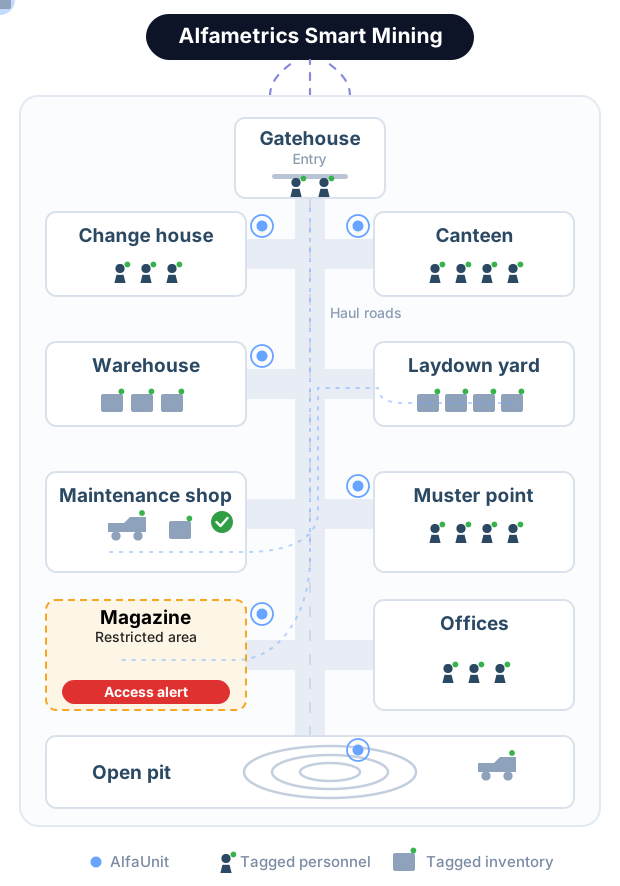
- Restricted areas such as the explosives magazine: entry raises an alert at that moment, not in the following day's report.
- Muster point: during an evacuation, the count of who made it and who is missing comes from the system, not from a list checked off by hand.
- Historical record of dwell time and zone changes for every unit, available to review any past shift.
Real productivity: Time on Tools
Time on Tools measures what share of the shift is actually spent on the task, and how much goes to travel, waiting, shift handover and stoppages. On a large site that difference is the margin: the workforce is already paid for, the question is how much of that time reaches the work face.
- It calculates itself. The indicator comes from the position and dwell time the system already records, not from a spreadsheet someone fills in at the end of the day or a one-off study run once a year.
- It separates support time from lost time. Travel is not wasted time: it is necessary time that can be shortened. Seeing it broken out is what lets you decide where to intervene.
- It compares shifts, crews and areas on the same basis and over the same period, instead of debating impressions.
- Bottlenecks become visible. When time piles up at one point in the process, it shows in the data before it shows in the complaints.
- Heat maps of occupancy and movement, to see where activity actually concentrates.
- Historical traceability of every event in the workflow: dwell times, zone changes and the full sequence of the shift.
- Integrates with your ERP over a REST API, so the indicator sits alongside the hours and costs you already manage.
- Dashboard on desktop, smartphone or tablet, covering both the shift in progress and the history.
Zone validation: work, rest, meals and travel
Time on Tools depends on a prior definition: what counts as what. Every zone on the site is declared in the platform, and from there dwell time and zone changes are recorded without anyone intervening.
- Work face: the zone where the task actually happens.
- Rest areas: legitimate and necessary time, measured as such and not confused with a process stoppage.
- Canteen and meals: real dwell time, also useful for sizing meal rotations and capacity.
- Travel: the time between one zone and another, usually the largest loss on extensive sites and the least measured.
- Change house and gatehouse: the real start and end of the shift, against the nominal schedule.
- Restricted zones: controlled access with an immediate alert on entry.
Measuring productivity under Chile's data protection law
Chile's Law 21,719 on personal data protection takes effect on 1 December 2026, and projects are on hold waiting for clarity. Here it is: indicators are delivered aggregated by crew, shift and zone, not as tracking of individuals, and what underpins the calculation is dwell time per zone — the minimum data required. The operating company remains the data controller; we provide the technical traceability to support that position, and the historical record to evidence what was measured and when.
Inventory that actually exists
In site warehouses and laydown yards, the gap between the stock the system declares and the stock the operation can find gets paid for three times: in the search, in the stoppage it causes, and in buying something that was already bought.
Ghost inventory and losses in the yard
- Stock stops being a declaration and becomes a position. With every unit tagged, existence is not asserted — it is located.
- The search in the yard ends. Finding a piece of equipment among stacks, containers and open areas no longer depends on who remembers where it was left.
- Duplicate purchases avoided. Equipment that cannot be found ends up in a purchase order for something that already exists. Locating it before the order is raised breaks that cycle.
- Usage and rotation cycles per unit: how long an asset has sat still, where it is stopped, and how often it is genuinely used.
- Stocktakes without halting the operation, against live data instead of a scheduled manual count.
Business rules and replenishment
- FIFO: consume first what arrived first, with the entry date recorded by the system itself rather than noted separately.
- Expiry: an alert before a batch expires in the warehouse, not once it already has to be written off.
- Minimum stock: set the minimum per item and have the system raise the alert or trigger replenishment when it is reached.
- Rules per item and per zone: maximum dwell times, authorised locations, and deviations worth flagging.
- ERP integration over a REST API, bidirectionally: the rule fires where the data lives and the purchase is handled where purchasing already happens.
Access, vehicle movements and AI video analytics
The gatehouse and control points concentrate two questions that are usually answered by hand: which vehicles came in, and what is happening there right now. Computer vision automates both.
Vehicles and movements
- Vehicle counting per control point, with real entry and exit volumes by hour and by shift.
- Movement classification by vehicle type, separating productive flow from services and visitors.
- Automatic licence plate recognition with full traceability: the entry and exit history of each vehicle stays available for review, without anyone writing down a plate by hand.
- Cross-referenced with the operation: vehicle movement is read alongside dwell time per zone, so a truck stopped longer than it should be shows up as data, not as a remark at shift handover.
Risks detected as they happen
- Worker fatigue: detection of fatigue signals so you can act before the incident, not after the report.
- Equipment failures and hazardous conditions detected from the process imagery.
- Theft and suspicious activity: notification while it is happening. The camera stops being an archive reviewed after the fact and becomes one more sensor.
- Integrated with the alerts that already exist per zone and deviation, in the same dashboard and over the same REST API.
Image analysis of people deserves separate treatment: biometric data is sensitive data under Chile's Law 21,719 and its regime is stricter than the rest. The scope, the purpose and the information given to workers should be defined with your legal and industrial relations teams before this capability is switched on.
How it works on the ground
A mine site is precisely where the usual technologies fail: GPS does not reach underground, and fixed read gates only record the instant someone crosses a door.
- Precise positioning without GPS. Using AlfaUnits IoT devices, RTLS technology and artificial intelligence, we determine position to within a few centimetres — and how that position moves.
- No fixed read gates. BLE makes it possible to know where a device is at all times, not only when it crosses a control point. That is the fundamental difference with RFID.
- Tags on people, equipment and inventory, with materials designed to be harmless and frequencies that do not interfere with nearby devices.
- Telemetry of the production environment: electrical consumption, motor ON/OFF status, fluid leaks and gas measurement.
- Early alerts on out-of-range parameters or process deviations, so you act before rather than after.
- SaaS model: Alfametrics absorbs much of the start-up cost and the subscription is sized to what needs covering. Time-boxed pilot plans are available to test it on your operation.
The same platform, in other industries
The underlying technology is the same; what changes is what gets measured and which rules apply. These pages are currently available in Spanish only.
- Smart Agro: post-harvest processes, exposure times that affect fruit condition, and automated stacking of pallets and bins in cold storage.
- Smart Industry: plants and distribution centres, with the position and dwell time of every inventory unit and bottlenecks in plain view.
Frequently asked questions from mining operations
-
Is this surveillance of workers?
No. Productivity indicators are delivered aggregated by crew, shift and zone, and they answer where time is lost in the operation, not what a specific person did. That distinction also matters legally: aggregated data that does not allow anyone to be identified stops being personal data. A worker's location is personal data under Chile's Law 21,719, and processing it requires a declared purpose, proportionality, data minimisation and notice to the people involved; the company operating the site is responsible for defining those terms.
-
How is Time on Tools measured without anyone filling in a report?
It is calculated from the dwell time per zone and the zone changes the system already records automatically. Site zones — work face, change house, canteen, rest areas, travel — are defined once, and from there the indicator builds itself, shift after shift, with no spreadsheets and no one-off sampling studies.
-
Does it work underground, where there is no GPS signal?
Yes, and that is precisely the case it was designed for. Positioning is achieved with AlfaUnits IoT devices deployed across the zones to be covered: using latest-generation RTLS technology and artificial intelligence it is possible to determine a position to within a few centimetres, and how that position moves, including where GPS does not reach.
-
What is ghost inventory and how is it eliminated?
It is the stock the system declares as available and the operation cannot find when it needs it. It is corrected by changing the nature of the record: with every unit tagged, existence stops being a number declared in a spreadsheet and becomes a position you can verify live. That also cuts off repurchases of equipment that did exist but could not be found.
-
Does it integrate with the ERP we already use?
Yes. We provide a REST API that unifies data bidirectionally with your ERP, so business rules — minimum stock, FIFO, expiry — can trigger replenishment where purchasing is already managed, without duplicating the process across two platforms.
-
Do licence plate recognition and vehicle counting need a separate installation?
They are computer vision capabilities that add to the same platform: vehicle counting, movement classification and automatic licence plate recognition feed the same dashboard and the same REST API as the rest of the operation, so vehicle movement is read alongside dwell time per zone. Detection of fatigue, equipment failures, theft and suspicious activity works on that same basis and raises notifications while events are happening.
Let's talk about your site
Tell us what you need to measure and we will tell you what can be done, at what scope and in what timeframe.
Message us directly at +56 9 5981 9579
To learn more about us or our services, write to contact@alfametrics.ai
Head office
Santiago, Chile